
live
Malta apartments don't have central heating — how long-stay renters actually
Malta flats have no central heating. Your AC in heat mode gives 2.5–4× more warmth per kWh than a plug-in heater: the cheapest option, plus the gas trap.
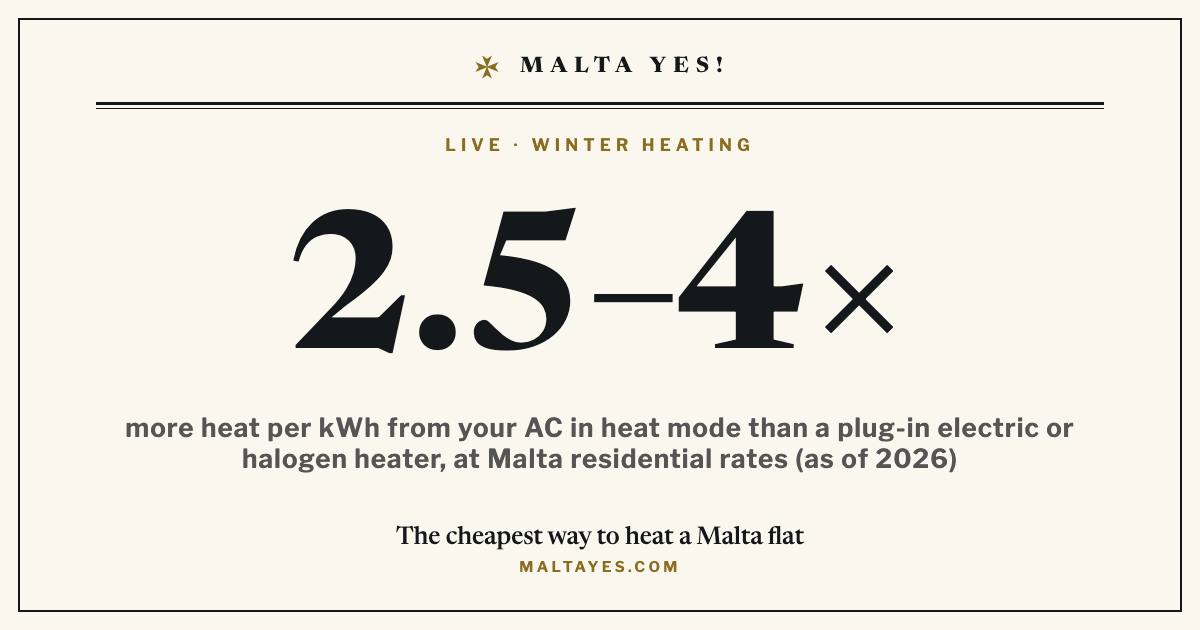
If you are renting a Malta flat for the winter, the first thing to know is that it almost certainly has no central heating — and the cheapest safe way to warm it is usually the air-conditioning unit already on the wall, run in heat mode. A reverse-cycle AC moves heat rather than making it, so it delivers roughly two-and-a-half to four times more warmth per unit of electricity than a plug-in electric or halogen heater. Gas cylinder heaters are the common fallback, but they carry a real safety catch that most guides skip. Here is how to stay warm cheaply, and safely, from November to March.
Key facts
- No central heating. Almost no Malta home has ducted central heating; the default is the summer AC unit run in heat mode.
- Your AC is likely your cheapest heater. A reverse-cycle unit gives 2.5–4× more heat per kWh than a plug-in electric or halogen heater, at Malta’s Residential rates (€0.1047–0.1607/kWh).
- Gas cylinders are the common fallback. A 12kg Liquigas Lite cylinder is €19 (including a €4 service charge) and gives roughly 35 hours of heat from a typical cabinet heater — costlier per unit of heat than the AC route.
- The safety point most guides skip: an unflued gas or combustion heater in a sealed room can cause fatal carbon-monoxide poisoning. Malta has had deaths. Always ventilate.
- Get on the right tariff first. The Residential electricity tariff is materially cheaper per kWh than Domestic; being on it changes the heating maths.
- Malta’s winter is mild but damp: daytime highs of 15–18°C, overnight lows of 9–12°C, wettest in December and January — a damp cold that feels worse indoors than the thermometer says.
Why Malta flats get so cold
Malta’s homes are built for summer, not winter. Most are limestone (franka) construction with little or no insulation, designed to shrug off August heat rather than hold warmth in. The same thick, heavy walls that keep a flat pleasantly cool in summer are slow to warm once the cold sets in — and it is genuinely normal for a Maltese flat to feel colder inside than the air temperature outside. The cold itself is mild by northern-European standards: daytime highs sit around 15–18°C and overnight lows around 9–12°C, with December and January the wettest months. But it is a damp cold, and damp air feels much colder than dry air at the same temperature. That damp is a large part of why a “16°C” flat in Malta can feel far chillier than “16°C” would at home, and why cold tile floors and unheated stone walls are the everyday winter complaint.
Your options, compared
Three things do most of the heating in Malta, and they are not equal.
| How you heat it | What it costs | The catch |
|---|---|---|
| AC in heat mode (heat pump) | Cheapest per unit of heat — 2.5–4× more warmth per kWh than a plug-in heater | Only if the unit works and you are on the cheaper Residential tariff |
| Gas cylinder (LPG) | About €19 per 12kg cylinder (incl. €4 service), roughly 35 hours of heat | Carbon-monoxide risk — never run it in a sealed room |
| Electric / halogen heater | Most expensive per unit of heat (no multiplier) | Cheap to buy, safe, and portable — fine for short bursts or one person |
The counter-intuitive winner is the appliance you already have. Nearly every Malta flat comes with a reverse-cycle air conditioner for the summer, and that same unit, switched to heat mode, is almost certainly the cheapest way to warm the room. It works as a heat pump: instead of turning electricity straight into heat like a bar fire, it uses electricity to move heat from outside to inside, which is why it produces two-and-a-half to four times more warmth per unit of power than a plug-in electric or halogen heater. Those plug-in heaters are cheap to buy and perfectly safe, but they are the most expensive way to make heat, so they are best kept for short bursts or heating one person rather than a whole flat.
What each one actually costs to run
The exact figures depend on your tariff and how hard you run the heat, but the ranking is stable. On Malta’s Residential electricity tariff, a unit of electricity costs somewhere between €0.1047 and €0.1607 per kWh depending on your consumption band. Because the AC delivers 2.5–4 units of heat for every unit of electricity it draws, it makes the most heat for the least money. A gas cylinder is the middle option: a 12kg Liquigas Lite cylinder currently costs €19 (that price includes a €4 service charge), and a typical 4.2kW cabinet heater burns roughly a third of a kilogram an hour at full output — about 35 hours of heat per cylinder. That works out dearer per unit of heat than the AC, but it has one real advantage: it does not depend on a working AC unit or on the mains staying on. The plug-in electric heater is the most expensive of the three for the heat it gives, and is best thought of as a spot heater, not a whole-room solution.
The safety point most guides skip
This is the part a cheap-tips listicle leaves out, and it matters more than any saving. An unflued gas or combustion heater — a gas cabinet heater, or worse, anything burning charcoal or wood — releases carbon monoxide, an invisible, odourless gas that is deadly in an unventilated room. This is not a distant risk. Malta has had fatal cases in exactly this scenario: a man in Msida died of carbon-monoxide poisoning after using a barbecue as an indoor heater in his bedroom because he was cold, and in a separate case a couple died in a poorly ventilated Gozo cottage after a stove was lit for warmth. The rule is simple and non-negotiable: never run an unflued gas or combustion heater in a sealed room. Keep a window slightly open for airflow, never use a barbecue or any charcoal appliance indoors, and fit a battery carbon-monoxide alarm — they cost very little — if you will use gas heat at all. If you are coming from a country where unflued kerosene or gas heaters are common, you already know this habit: the same “crack a window every so often” rule you use at home applies directly here.
Get your bill right first: the ARMS tariff
Before you spend a cent on heating, check which electricity tariff your flat is on, because it quietly sets the whole cost of the AC route. Malta’s utility billing (through ARMS) splits into a cheaper Residential rate and a more expensive Domestic one, and many tenants are unknowingly left on the wrong one. Getting onto the Residential tariff, where you are eligible, is a paperwork job — the Form H process — and it can materially lower the running cost of heating your flat all winter. We cover exactly how in our guide to the ARMS bill trap and Form H; read it before you budget for winter, because heating a flat cheaply starts with the rate you pay per unit, not the heater you buy. It is one piece of the wider admin of setting up a long stay in Malta, where the default contract is rarely the one that suits a short stay.
What to check with a landlord before you sign
A winter let is a different proposition from a summer one, so ask before you sign, not after. Find out whether the air-conditioning units actually have a working heat mode (not all older units do), and whether they are serviced. Ask which ARMS tariff the flat is on and whether bills are in your name or the landlord’s, since that decides whether you can switch to the Residential rate. If the flat relies on gas heaters, ask how ventilation works in the rooms you would heat, and whether there is a carbon-monoxide alarm. Ask, too, about damp: whether the flat has a dehumidifier, and how the bedrooms fare in a wet December. None of this is unusual to raise, and a good landlord will have answers. For the wider winter picture — what the season is actually like and when the wet months hit — our guide to Malta in the off-season sets the scene. (One related but separate problem worth a mention: the same damp that makes the cold bite is also what drives winter mould, which is its own issue of moisture rather than temperature.)
Frequently asked questions
Why don't Malta apartments have central heating?
Because Malta's building stock was designed for a hot climate, not a cold one. Homes are mostly thick limestone with little insulation, built to stay cool through a fierce summer rather than to retain warmth in winter. With only a few genuinely cold months, ducted central heating was never standard, so almost no residential building has it. Instead, nearly every flat has a reverse-cycle air conditioner installed for the summer, and that unit — run in heat mode — is what most people use for warmth.
What's the cheapest way to heat a Malta apartment in winter?
Usually the air-conditioning unit you already have, run in heat mode. Because a reverse-cycle AC moves heat rather than generating it, it produces about 2.5–4 times more warmth per unit of electricity than a plug-in electric or halogen heater, which makes it the cheapest option per unit of heat on Malta's Residential tariff. A gas cylinder heater is the middle option and useful when you cannot rely on the AC; plug-in electric heaters are the most expensive way to make heat and are best kept for short bursts.
Are gas heaters safe to use indoors in Malta?
Only with proper ventilation. An unflued gas or combustion heater releases carbon monoxide, an odourless, invisible gas that can be fatal in a sealed room, and Malta has had deaths from exactly this — including someone using a barbecue indoors for warmth. If you use a gas cabinet heater, always keep a window slightly open, never use charcoal or a barbecue indoors, and fit an inexpensive battery carbon-monoxide alarm. Used with airflow, a gas heater is a normal tool; used in a sealed room, it is dangerous.
What should I ask a landlord about heating before signing a long let?
Ask whether the AC units have a working, serviced heat mode; which ARMS tariff the flat is on (Residential is cheaper) and whether the bills are in your name so you can switch; how the rooms you would heat are ventilated if gas is involved, and whether there is a carbon-monoxide alarm; and how the flat handles damp, including whether there is a dehumidifier. A winter let lives or dies on these details, and a good landlord will answer them all without hesitation. ---