
explore
'When to rock climb in Malta: the real season, and where to climb once summer
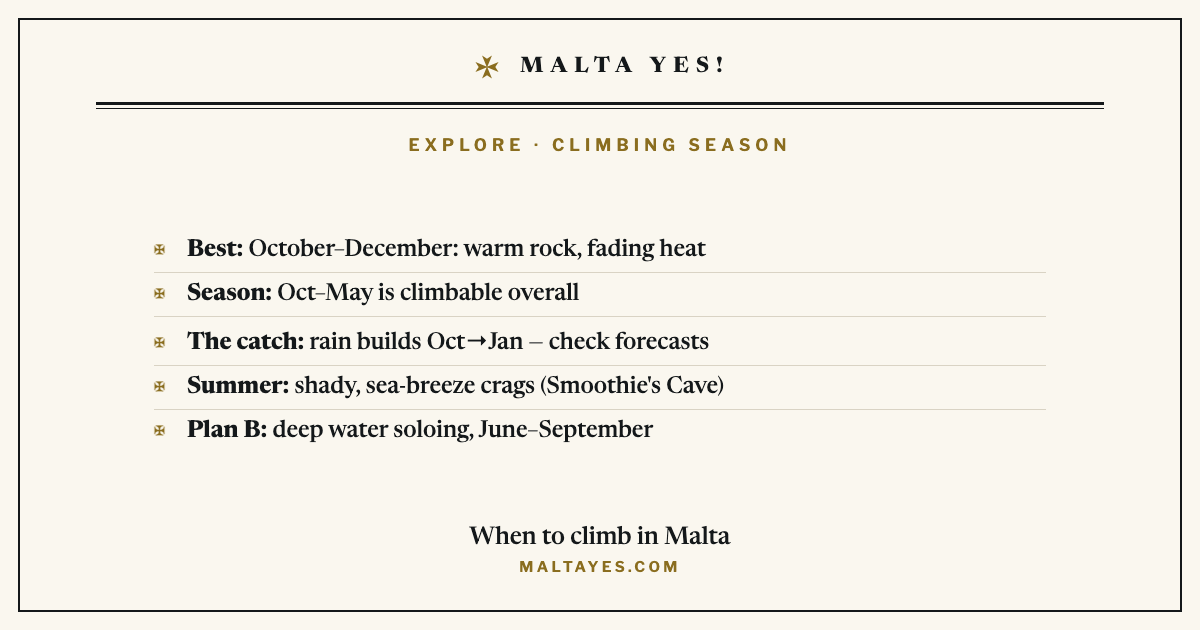
October to December is peak climbing season on Malta's limestone; the season runs Oct–May. In summer, try shady crags or deep water soloing.
If you are planning a climbing trip to Malta, here is the short answer: October to December is the best time to rock climb here, and the wider season runs from October through to May. Summer is not a write-off, but from June to September the exposed limestone bakes in the sun, so you climb in the shade, catch the sea breeze, or switch to deep water soloing over the water. This guide runs through the real season, why autumn wins, the one catch nobody mentions, and where to keep climbing when the heat arrives.
Key facts (as of 2026)
- Best months — early October to December: warm rock, the summer heat fading, and days still long enough for a full session.
- Full season — October to May is climbable overall; spring is the quieter twin of autumn.
- The catch — rain builds through autumn (roughly 6 wet days in October, 9 in November, 10 in December) toward the January peak. [VERIFY]
- Summer — from June to September, stick to shady, sea-breeze crags; Valletta’s average high is 32°C in August, up to 34°C on hot days.
- Plan B — deep water soloing (climbing over deep sea, no rope) keeps you on rock all summer; the sea is still 26.5°C in August.
The short answer: October to May, best in autumn
Malta is a climbing destination you visit for its sport routes on sea-cliff and inland limestone. The comfortable season runs from October to May. Within that, local guidebook authors and the climbing media agree that early October to December gives the best conditions: the fierce summer heat has broken, the rock is warm but no longer scorching, and the days are still long enough for a full session. If you only get to pick one month, pick October.
For a wider view of when the island is at its best for outdoor plans, our guide to the best time to visit between September and November covers the same shoulder-season logic across activities.
Why autumn wins: warm rock, broken heat
Three things line up in autumn. First, temperature: the searing summer highs have dropped, but the rock has soaked up months of warmth, so your fingers and shoes grip better than on cold winter stone. Climbers call this friction, and warm-but-not-hot limestone gives you the best of it. Second, rock condition: after a dry summer the crags are solid, before the winter rains make some sea-level routes greasy. Third, daylight: October still gives you a long enough day to walk in, warm up and climb a full route list without racing the sunset.
If you already know you want to be on real rock rather than a climbing wall, the classic first stop is the via ferrata and sport routes at Wied Babu near Żurrieq, which come into their own once the autumn heat eases.
The catch nobody mentions: autumn is also when the rain builds
Here is the part the one-line “best time” answers leave out. The autumn months climbers love are also when Malta’s rain returns. [VERIFY] Wet days climb steadily — very roughly six in October, nine in November and ten in December — heading toward the January peak. That does not ruin the season; most autumn days are still dry and warm. But it does mean you should check the forecast even in the “good” months, keep a flexible day or two in your trip, and have a backup ready. A washed-out afternoon is far more likely in December than October, so if rain would sink your trip, lean earlier in the window.
Winter and spring: the quieter, still-good season
Climbing does not stop after December. January and February are the wettest months, but Malta’s winters are mild and full of dry, bright spells — pick your days around the weather and the rock is perfectly climbable, with the crags almost to yourself. Then spring, roughly March to May, is autumn’s quieter twin: the heat is building again but not yet punishing, the rain is easing off, and conditions are excellent. If you want the good rock of autumn without the rising rain, spring is arguably the smarter booking.
Can you climb in July and August? Yes — if you go about it right
Yes, but plan around the heat rather than pretending it is not there. August is genuinely brutal on exposed rock: Valletta’s average high sits at 32°C, hot days reach 34°C, and a south-facing limestone wall in direct sun is hotter still. Climb that in the middle of the day and you will cook. The summer strategy is simple: go early in the morning or late in the day, stay out of direct sun, and chase the sea breeze. Get that right and you can still climb through July and August — you just do it differently from an October visitor.
The same heat logic shapes every summer sport here; our guide to trail running in Malta makes the same case for dawn starts and shade, if you want to mix your trip up.
Shady, sea-breeze crags for summer
A crag is simply a cliff or rock face that climbers use. In summer the ones that stay usable are those in shade for much of the day and open to the wind off the sea. The best-known example is Smoothie’s Cave, which has become popular right through the summer for exactly this reason: it offers plenty of shade and a cooling wind off the water. Cave and overhang crags like this keep the sun off you and let the breeze do the rest. If the outdoor heat still wins, Malta has an indoor option too — a session on the padded walls of an air-conditioned bouldering gym is the coolest climbing on the island in August.
Deep water soloing: the built-in summer plan B
Malta’s real summer answer is deep water soloing, or DWS: climbing on sea cliffs without a rope, with deep water beneath you instead of a crash pad, so a fall just drops you into the sea. It is the reason a summer climbing trip here still works. Malta’s climbing club maintains a list of around fifteen DWS and sea-level traversing venues around the islands — among them Għar Ħasan, Wied Żnuber, Red Wall, Għar Lapsi, Comino’s Lantern Point and Mġarr ix-Xini in Gozo. The sea stays warm and swimmable far past peak summer — about 26.5°C in August and still 24°C in October — so the DWS window runs comfortably from June into the autumn.
DWS routes are graded for how safe the fall is, from S0 (clean, deep landings) up to S3 (treat it like a rope-free solo, where a bad fall could hurt you). Beginners should stick to S0 and S1 venues and always go with someone who knows the spot. Our full deep water soloing guide covers the venues, grades and safety in detail — bookmark it as your summer plan B. If you would rather stay low and close to the ground while the sun is at its worst, bouldering around Malta and Gozo is another rope-free way to keep climbing.
Season at a glance (month by month)
- October — the pick of the year: warm rock, heat gone, rain not yet heavy.
- November–December — still excellent, but pack for rain and watch the forecast.
- January–February — wettest months, yet plenty of dry, mild days and empty crags.
- March–May — spring, autumn’s quieter twin: warming up, drying out, very good.
- June–September — heat is on; climb shady sea-breeze crags at dawn, or go DWS.
Frequently asked questions
Is Malta too hot to climb in summer?
Not if you plan around it. Exposed, south-facing limestone in the midday sun is genuinely too hot — August highs average 32°C and reach 34°C. But shady crags that catch the sea breeze, such as Smoothie's Cave, stay usable, and deep water soloing over the sea keeps you climbing right through June to September. The trick is to climb early or late, avoid direct sun, and follow the wind off the water.
What is the best month to rock climb in Malta?
October. Local guidebook authors and climbing media point to early October through December as the optimum window, and October leads it: the summer heat has broken, the limestone is warm enough for good grip, the days are still long, and the heavy winter rain has not yet arrived. November and December are still very good, but your chance of a wet day rises as you move toward January.
Can beginners deep water solo in Malta?
Yes, with care. Deep water soloing venues are graded from S0, meaning clean and deep landings, up to S3, which should be treated like a rope-free solo route. Beginners should stick to S0 and S1 spots, go with someone who already knows the venue, and check the water depth and the entry and exit points first. Started sensibly, it is one of the most enjoyable ways to climb in a Maltese summer.
Does the "best" October–December window come with rain?
Some, and it increases through the season. [VERIFY] Wet days roughly double from October to December on the way to the January peak — very approximately six, then nine, then ten. Most days are still dry and warm, so the window remains the best of the year, but you should check the forecast even in these months, keep your plans flexible, and have a coastal or indoor backup ready.