
live
'Renewing the Nomad Residence Permit after year one: the 5-month residence
Renewing Malta's Nomad Residence Permit needs proof of 5 months' residence, a €300 fee and filing 2–3 months before expiry. The 4-year cap, explained.
If your Malta Nomad Residence Permit is coming up to its first anniversary, renewal is simpler than the original application in some ways and stricter in others. The three things first-timers do not expect: you must prove you actually spent about five months in Malta over the past year, you re-prove your income against the threshold that applied when you were first approved, and you apply two to three months before your permit expires — not the week before. This guide walks through what changes, what to gather, and the four-year ceiling that decides how long this route can last.
Key facts (as of 2026)
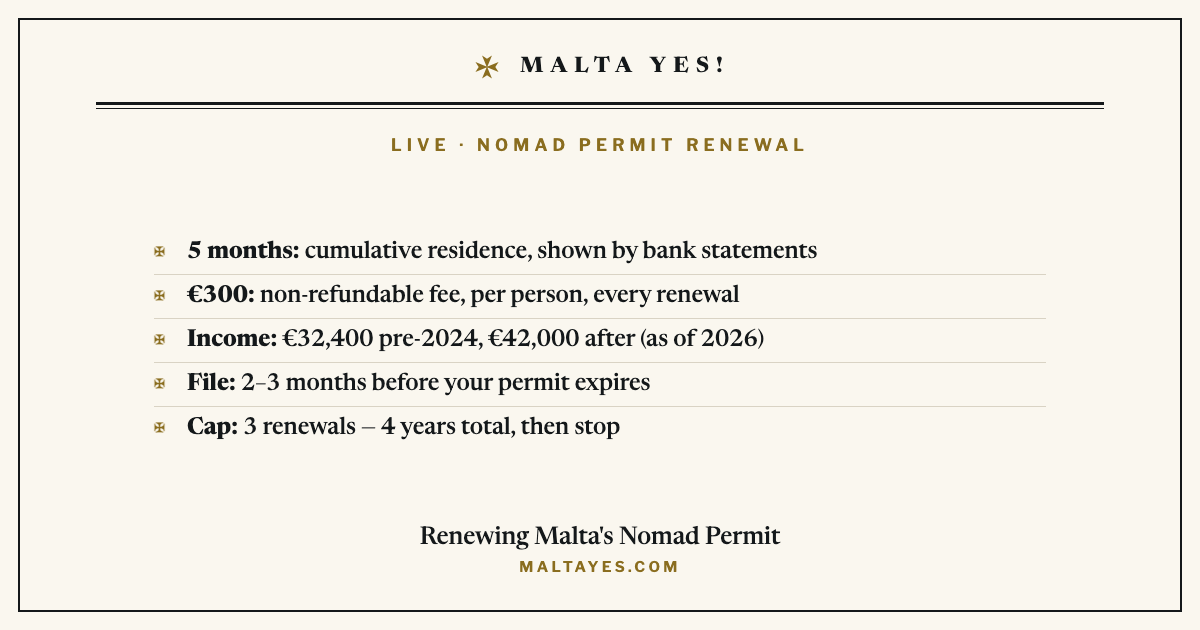
- 5 months in Malta — you must show a cumulative (not necessarily consecutive) five months of physical residence over the previous twelve, proven by a bank statement with Malta-based transactions.
- €300 fee — non-refundable, charged per applicant and per family member, on the original application and on every renewal.
- Income threshold — €32,400 a year gross if you were first approved before 1 April 2024; €42,000 a year if approved on or after that date.
- Apply 2–3 months early — submit your renewal two to three months before the current permit expires, not at the last minute.
- Four-year ceiling — the permit can be renewed a maximum of three times, so the longest total stay on this route is four years.
What actually changes at renewal
The first application was about proving you could live in Malta: a remote job or clients outside Malta, enough income, health insurance, and somewhere to stay. Renewal keeps all of that, but adds one test the first application could not ask of you — whether you genuinely used the permit. That is the five-month residence rule below. In practice, renewal is less about paperwork you have never seen and more about evidence you should have been quietly building all year: bank activity in Malta, a lease, ongoing income. If your first year on the permit was the one described in our guide to working remotely from Malta on the Nomad Residence Permit, most of what renewal wants already exists in your accounts.
The 5-month rule: what counts, and how you prove it
This is the requirement that catches people out. To renew, you must show that you were physically resident in Malta for a cumulative five months over the previous twelve. Cumulative is the key word: the months do not have to be consecutive. You can leave Malta, travel, come back, and still qualify, as long as the total adds up to roughly five months across the year.
You prove it with a bank statement showing Malta-based transactions — everyday spending in Malta (card payments, cash withdrawals, bills) that shows you were actually here, not just holding the permit from abroad. The practical lesson is to spend locally on a traceable card while you are in Malta, rather than living on cash or a foreign account, so the evidence builds itself. If you are still deciding where to base yourself for that time, our comparison of basing yourself in Gozo instead of Malta and our look at why St Paul’s Bay suits many long-stayers both cover the trade-offs.
Re-proving income: the €32,400 vs €42,000 split
At renewal you must show you still meet the income threshold — but which threshold depends on when you were first approved. If your original permit was approved before 1 April 2024, you keep the earlier figure of €32,400 a year gross. If you were approved on or after 1 April 2024, you are held to the higher €42,000 a year. This “grandfathering” matters: an earlier applicant renewing in 2026 is not suddenly moved up to the new, higher number.
To evidence it, employed, self-employed and freelance applicants submit three months of bank statements showing income arriving, plus proof of a guaranteed income source for at least five cumulative months from the date you apply. In other words, the authority wants to see both a recent track record and reasonable confidence the income continues.
Documents checklist: what to gather first
Before you start the renewal, pull these together:
- A bank statement covering the year that shows a cumulative five months of Malta-based transactions (the residence proof).
- Three months of bank statements showing your income arriving (the income proof).
- Evidence of a guaranteed income source for at least five cumulative months from your application date.
- Your current lease or accommodation proof, and valid health insurance.
- The €300 fee per person — remember it also applies to each family member on the permit.
Two format rules trip people up. Every document must be in English, or come with an English translation. And bank statements must be official exports from the bank — proper statements, not phone screenshots — submitted as PDFs. A screenshot of your banking app will be rejected.
Timing: why 2–3 months before expiry matters
Submit your renewal two to three months before your current permit expires. This is not a suggestion to be early for its own sake — processing takes time, and you want the decision back before your existing permit lapses so there is no gap in your legal residence. Leaving it to the final weeks risks your permit expiring while the renewal is still being assessed. [VERIFY: an older official checklist cited a 45-day minimum; the current guidance is 2–3 months. Processing-time figures also conflict between sources (30 days vs 60 working days) — confirm the live official timeframe before relying on it.] Set a reminder for the three-month mark rather than trusting yourself to remember.
The four-year ceiling: what happens after renewal #3
The Nomad Residence Permit is not an indefinite route. Since 1 April 2024 it can be renewed a third time, which raised the maximum total stay from three years to four. But four years is the ceiling: after your third renewal, this permit cannot be extended again. If Malta is becoming a longer-term home rather than a multi-year base, the four-year mark is when you need a different plan — a change of status or another residence route — worked out well before the clock runs down.
Common mistakes first-time renewers make
The recurring ones are avoidable. Living on cash or a foreign card, so there is no Malta transaction trail to prove the five months. Assuming the residence months must be one continuous block, and panicking over ordinary travel. Forgetting the €300 fee multiplies by each family member. Submitting screenshots instead of official bank statements. And leaving the application to the last fortnight, then facing a gap when the permit expires mid-assessment. None of these are hard to avoid once you know they are coming — which is the whole point of reading this a few months ahead.
Frequently asked questions
Do I need to spend five months in Malta consecutively to renew?
No. Residency Malta counts a cumulative, non-consecutive total of about five months across the previous twelve. You can travel in and out of Malta during the year and still qualify, as long as the days you were physically present add up to roughly five months. What matters is the total, evidenced by a bank statement showing Malta-based transactions across that period — so keep spending locally on a traceable card while you are here.
Can I keep renewing the Nomad Residence Permit indefinitely?
No. The permit can be renewed a maximum of three times. Since the April 2024 change added a third renewal, the longest total stay on this route is four years. After that, the Nomad Residence Permit cannot be extended further, so anyone planning to stay in Malta beyond four years needs to move to a different residence route before the fourth year ends.
Does my income threshold change when I renew?
Only if you were first approved on or after 1 April 2024. Applicants approved before that date keep the original €32,400 a year gross threshold at renewal, while anyone approved from 1 April 2024 onwards is held to the higher €42,000 a year. So an earlier holder renewing now is not automatically moved up to the new figure — the threshold that applied when you were first approved is the one you keep proving.
What happens if I fall short of the five-month residence requirement?
[VERIFY] There is no published grace period, so this is best treated as case-by-case rather than a fixed rule. If you think you may not reach the five cumulative months — because work or family kept you abroad for long stretches — the safest step is to contact Residency Malta directly before your window opens, rather than submitting and hoping. Confirm your own position with the Agency before relying on any general answer.